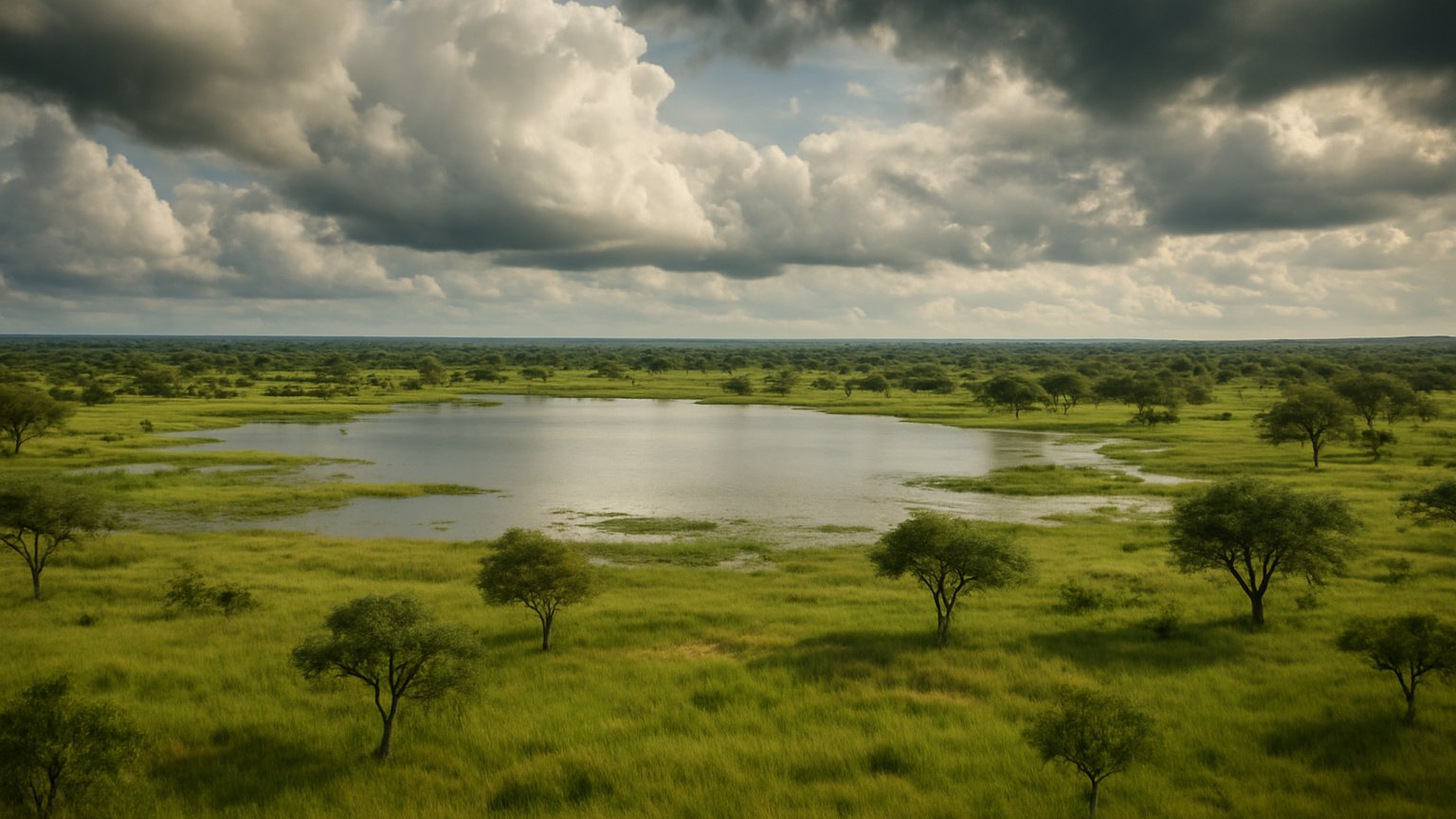
The Sahara is often pictured as one of Earth’s permanent deserts. Yet between roughly 11,000 and 5,000 years ago, much of North Africa looked radically different. During the African Humid Period, stronger summer monsoon rains filled parts of the Sahara and Sahel with rivers, wetlands and large lakes. Grasslands, wooded savannas and other vegetation spread across landscapes that are now dominated by dry sand and rock.
A greener North Africa
The African Humid Period was not a brief local anomaly. It was a major reorganization of the climate system across northern Africa. Areas of the modern Sahara supported more extensive vegetation, while the Sahel contained wetlands and lake-filled landscapes. Some reconstructed lakes in the Sahara and Sahel covered thousands of square kilometers. In the Sahel, a water body known as Megalake Chad may have exceeded 25,000 square kilometers.
The precise rainfall pattern was not identical everywhere. Scientists continue to refine how wet conditions varied from one region to another and how the humid period unfolded through time. However, the broad conclusion is clear: northern Africa was substantially wetter and greener than it is today during this interval.
The orbital trigger
One important part of the explanation lies in Earth’s orbit. The slow change known as orbital precession altered the seasonal distribution of sunlight. During the African Humid Period, it increased Northern Hemisphere summer sunlight. That extra seasonal heating helped intensify and shift the West African monsoon farther north.
A stronger monsoon carried more moisture over the continent. Summer rains reached regions that receive little precipitation under the modern climate, allowing water to collect in depressions and lake basins. Rivers and wetlands became more widespread, connecting parts of the landscape through surface water.
The orbital change did not work alone. Vegetation, soil properties and surface water reinforced the initial rainfall increase. Plants can alter how much sunlight the ground absorbs and how water moves back into the atmosphere. Soils and lakes also influence evaporation and moisture availability. Together, these feedbacks helped sustain and amplify the greener conditions created by the stronger monsoon.
How scientists know
The evidence comes from several independent sources. Pollen preserved in sediments records the plants that grew in different areas. Lake sediments reveal the presence of standing water and changing environmental conditions. Archaeological evidence shows that people occupied and used landscapes that were wetter and more productive than the modern Sahara. Ancient depictions of landscapes also contribute to the picture of a greener North Africa.
These records do not provide one perfectly uniform history for the entire Sahara. Conditions differed across regions, and the timing of changes was not exactly the same everywhere. That is why scientists continue to examine how rainfall, vegetation and lakes changed from place to place. Still, the combination of pollen, sediments, archaeology and landscape evidence strongly supports the existence of a dramatically greener Sahara.
Why the green Sahara matters
The humid period ended broadly around 5,000 years ago, as Northern Hemisphere summer sunlight declined and the African monsoon weakened. The transition was not identical throughout North Africa, but the broad result was a return toward drier conditions. Lakes and wetlands contracted, vegetation became less extensive and the desert landscape expanded.
This history matters because it shows how a relatively small, predictable change in Earth’s orbit can reorganize climate across an entire continent. It also demonstrates that rainfall, vegetation, soil and surface water can interact as a connected system. The Sahara’s past is therefore more than a story about a vanished landscape: it is evidence that deserts can respond dramatically when the balance of seasonal sunlight and climate feedbacks changes.