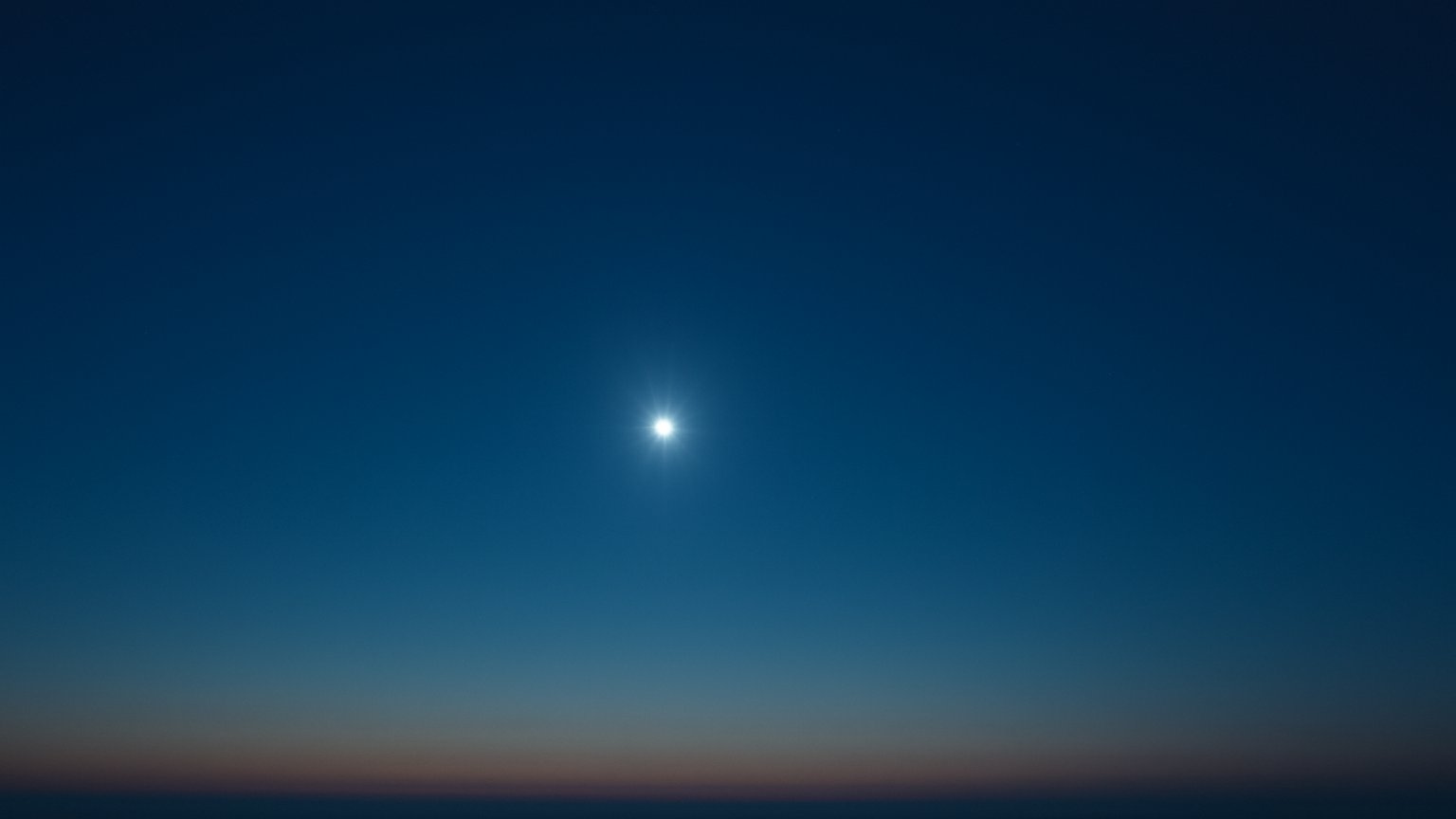
On November 25, 2026, Venus will reach the greatest brilliancy of its 2026 morning apparition. At approximately magnitude -4.9, the planet will appear as an exceptionally bright point of light low in the eastern sky before sunrise. It will outshine every star and can be seen without a telescope, provided the eastern horizon is clear and local conditions allow.
When and where to look
The moment of greatest brilliancy occurs at approximately 02:39 UTC on November 25. Because sunrise and the visibility of Venus depend on location, the best observing time will be during the local pre-dawn period, when Venus is above the eastern horizon but the sky has not yet become too bright.
This is a worldwide event in the sense that Venus can be observed from locations around the globe. However, visibility will vary with latitude, weather, the local time of sunrise, and the openness of the eastern horizon. Buildings, hills, trees, haze, and clouds near the horizon may hide the planet even when the sky overhead is clear.
Venus will be low in the eastern sky, so observers should choose a place with an unobstructed view in that direction. It is worth looking early enough to locate the planet while the sky is still relatively dark, but observers should never look directly at the Sun as it rises.
Why Venus becomes so bright
Venus is the brightest planet seen from Earth because it is relatively close to us and its cloud-covered atmosphere reflects a large amount of sunlight. Its brightness is measured using astronomical magnitude, a scale in which smaller and more negative numbers indicate brighter objects. A value near -4.9 therefore represents an unusually luminous appearance in the sky.
The brightness of Venus is not determined by distance alone. Its changing position around the Sun alters both its distance from Earth and the amount of its illuminated side facing us. These changing viewing angles also produce phases, much like the phases of the Moon. Around greatest brilliancy, Venus presents a balance between a strongly illuminated crescent and its position close enough to Earth to appear very bright overall.
The planet’s thick clouds are also important. They reflect sunlight efficiently, helping Venus stand out even when the surrounding sky is beginning to brighten before sunrise.
What the eye and telescope will show
To the unaided eye, Venus will look like a brilliant, steady object rather than a twinkling star. Its brightness makes this event accessible to casual observers as well as experienced skywatchers. No telescope is needed to identify the planet when it is visible low in the east before dawn.
A telescope will reveal a thin crescent phase. This is one of the most interesting features of the event: Venus can be dazzling to the naked eye while appearing only partly illuminated through an instrument. The crescent is a result of the same geometry that controls the planet’s changing brightness as Venus moves around the Sun.
Because the planet is low in the sky, atmospheric turbulence may make the telescopic view less stable than a view of an object higher overhead. Even so, the combination of exceptional brightness and a thin crescent makes November 25 a notable observation opportunity.
A bright and accessible morning sky event
Venus’s greatest brilliancy is striking precisely because it requires no specialized equipment. The event offers a simple way to connect an easily visible point of light with the orbital geometry of the inner Solar System. Observers only need a clear eastern horizon, suitable local weather, and a safe viewing time before sunrise.
The exact experience will differ from place to place. Some observers may see Venus against a dark pre-dawn sky, while others may find it closer to the increasing glow of sunrise. In every case, the essential sight is the same: Venus shining at approximately magnitude -4.9, brighter than any star, during the morning apparition of 2026.