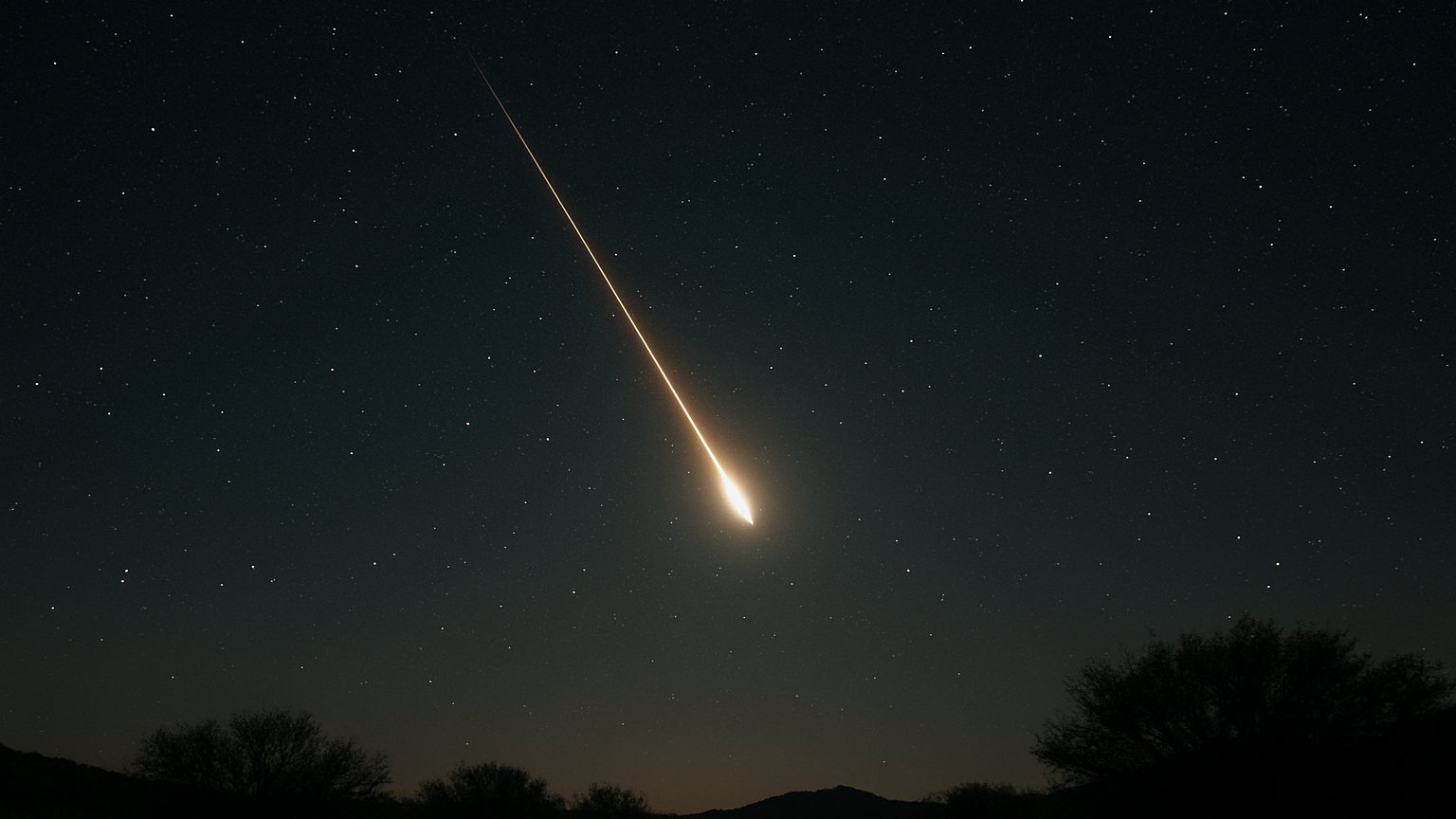
The Northern Taurid meteor shower reaches its peak overnight on November 11–12, 2026. It is not a high-rate shower: under ideal conditions, observers may see roughly five meteors per hour. Yet the Northern Taurids are valued for a different reason. Their meteors move relatively slowly and can occasionally produce exceptionally bright fireballs, giving this modest shower an outsized visual impact.
A quiet shower with a dramatic possibility
Meteor showers occur when Earth passes through a stream of dust and small rocky particles left behind by a comet or asteroid. As these particles enter Earth’s atmosphere at high speed, friction and compression heat the surrounding air and the particles themselves. The glowing streaks are what we call meteors.
The Northern Taurids are associated with debris from Comet 2P/Encke. Most of the particles are small and create brief points or streaks of light. Occasionally, however, a larger fragment enters the atmosphere. That can produce a fireball: a meteor that becomes exceptionally bright compared with ordinary shower members.
This contrast is the main attraction of the 2026 peak. The expected number of meteors is limited, but the shower can reward patience with a conspicuous flash that stands out against the night sky. A low hourly rate also means that an observer may spend considerable time watching before seeing a meteor.
When the peak occurs
Peak activity is expected during the night of November 11–12, 2026. The event is described as worldwide, with viewing opportunities in both the Northern and Southern Hemispheres. The exact number visible to an individual observer will depend on conditions such as cloud cover, local light pollution, the clarity of the atmosphere and how much sky is unobstructed.
The estimate of roughly five meteors per hour applies to ideal conditions rather than every viewing location. In a city or near bright artificial lights, many fainter meteors may disappear from view. A dark-sky location makes it easier to detect the shower’s less luminous members and gives any fireball a stronger contrast against the background.
Why the Moon matters
A thin crescent Moon will set early during the peak night. After it has gone below the horizon, moonlight will provide comparatively little interference for much of the remaining night. This is useful because a darker sky does not create more meteors, but it allows more of the faint ones to be seen.
For observation, the most important practical step is to give your eyes time to adapt to darkness. Avoiding bright lights and finding a broad, unobstructed view of the sky can improve the experience. Meteor showers do not require specialized equipment: binoculars and telescopes show only a small portion of the sky at once, while meteors can appear across a wide area. Comfortable unaided viewing is generally the most effective approach.
What makes the Northern Taurids memorable
The Northern Taurids illustrate why meteor-shower quality cannot be judged by numbers alone. A shower producing only a few meteors per hour may still be worth watching when its members are relatively slow and have a reputation for bright fireballs. Those fireballs are not guaranteed, and the shower should not be treated as a promise of a spectacular display. They are an occasional possibility within an otherwise restrained meteor event.
The combination of Comet 2P/Encke’s debris, the November 11–12 peak, and the early-setting thin crescent Moon creates favorable circumstances for patient observers. From dark-sky locations around the world, the Northern Taurids offer a chance to see a subtle meteor shower—and, potentially, one unusually brilliant moment.