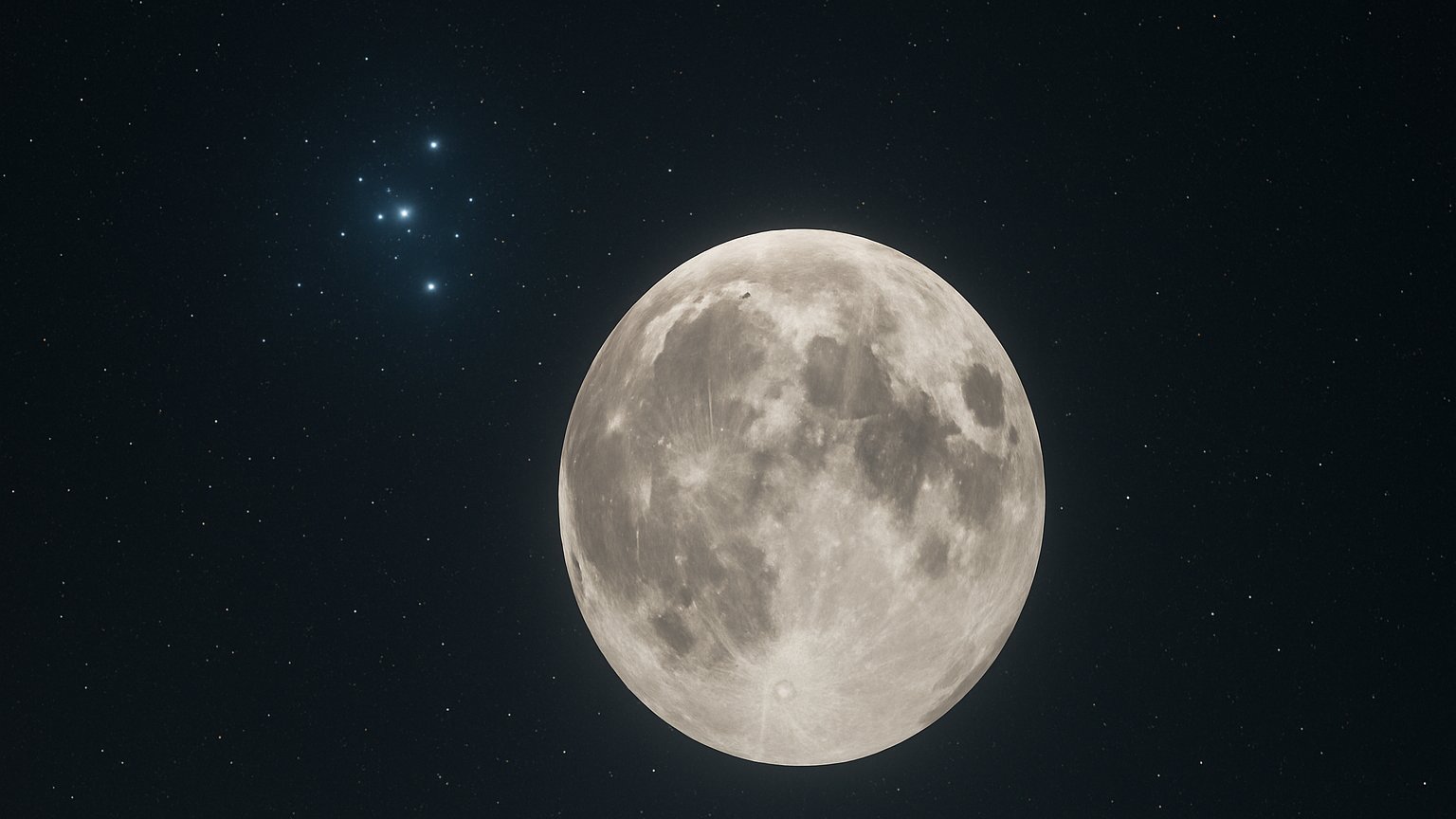
On the night of November 23, 2026, the nearly full Moon will appear remarkably close to the Pleiades star cluster in the constellation Taurus. The two objects will pass less than 1 degree apart, creating an easy-to-recognize pairing across much of the world. The scene will continue into November 24, although the exact viewing experience will depend on local moonrise times and the weather.
A close meeting in Taurus
The Pleiades are a compact open star cluster made up of young, luminous stars. They are often recognized as a small group of blue-white points gathered closely together in the night sky. On this occasion, the Moon will move through the same region of the sky, appearing almost alongside the cluster from Earth’s perspective.
A separation of less than 1 degree is small enough to make the event visually distinctive. The Moon will not actually be close to the Pleiades in space: the apparent meeting is caused by the alignment of objects at very different distances along our line of sight. This kind of apparent proximity is known as a conjunction or close approach.
Why the Moon will dominate the view
The Moon will be nearly full during the encounter, so its broad illuminated surface will be bright against the surrounding sky. That brightness can make the pairing especially easy to locate without optical equipment, but it also creates a challenge for observing the cluster. Moonlight may wash out some of the Pleiades’ fainter stars, leaving only the brighter members clearly visible.
This contrast between a brilliant lunar disk and a delicate star cluster is part of what makes the scene interesting. The Moon provides an obvious reference point, while the Pleiades add a compact pattern of stars nearby. Even when moonlight reduces the cluster’s detail, the overall arrangement should remain recognizable under suitable conditions.
How to observe the pairing
The event is suitable for naked-eye viewing, binoculars, and astrophotography. For unaided observers, the simplest approach is to look for the Moon during the night of November 23 and then identify the small star cluster close to it. Binoculars can reveal more of the Pleiades’ structure, although their field of view may make the very close pairing appear especially crowded.
The timing will vary from place to place. Visibility begins during the night of November 23 and continues into November 24, but observers will need the Moon to be above their local horizon. Clouds, haze, and other weather conditions can also determine whether the conjunction is visible. A clear, unobstructed view of the sky will provide the best opportunity.
A prelude to the November full Moon
The close approach occurs just before the November full Moon. Full Moon will take place on November 24, 2026, at approximately 14:53 UTC. This means the Moon will be approaching the brightest phase of its cycle as it passes the Pleiades, reinforcing the strong contrast between the illuminated lunar surface and the surrounding stars.
The event does not require a rare instrument or specialist equipment. Its appeal comes from the simplicity of the scene: a familiar bright Moon beside a compact, recognizable cluster. Because the pairing is visible across much of the world, many observers may be able to see it, provided local moonrise and weather conditions cooperate.