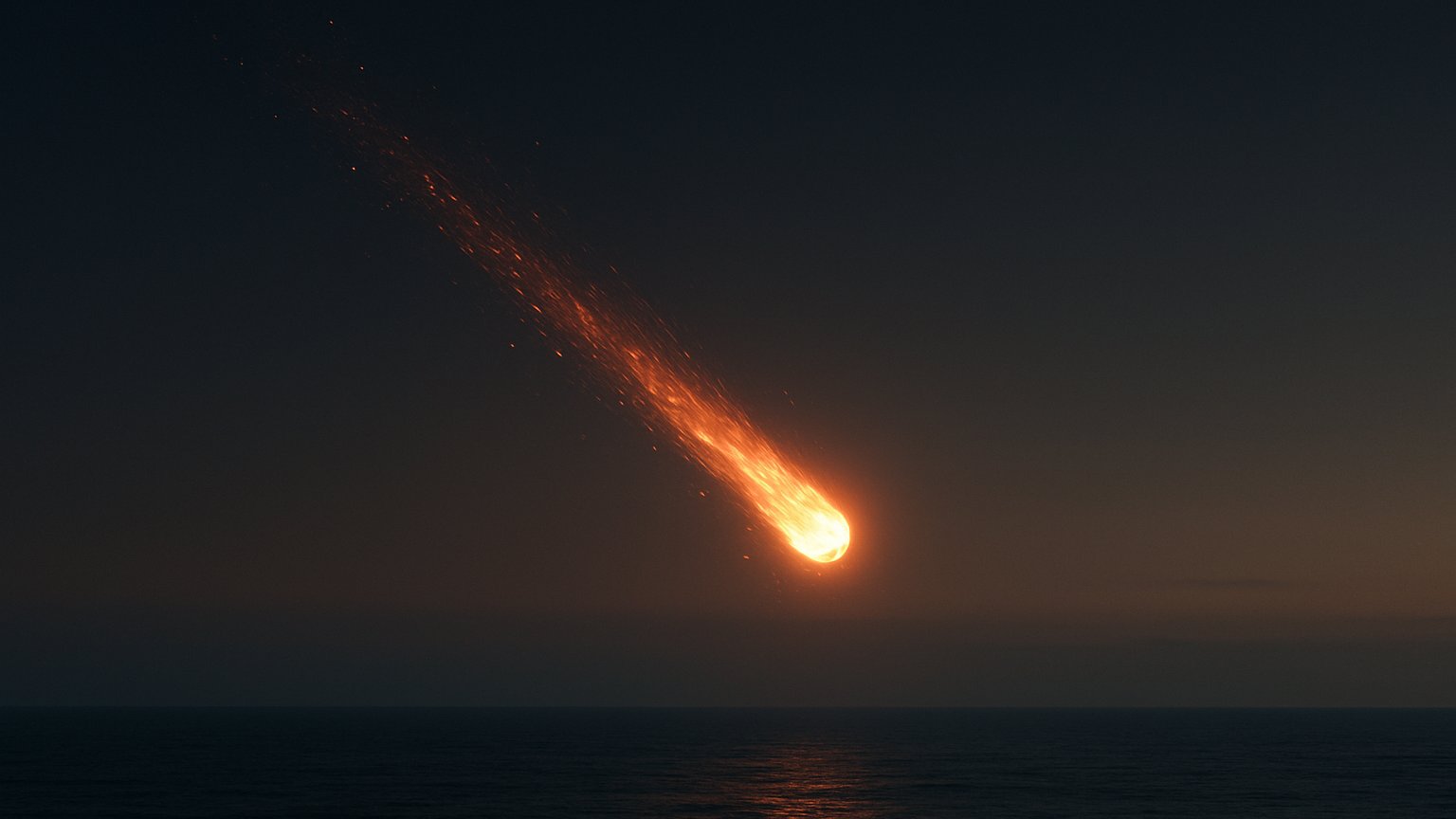
NASA’s Neil Gehrels Swift Observatory is expected to make its final passage through Earth’s atmosphere on Wednesday, November 4, 2026. Nearly 22 years after its launch, the roughly 3,200-pound space telescope is approaching the end of its mission in a dramatic way: most of the spacecraft should burn up during re-entry, potentially producing a short-lived fireball in the sky. The event is unusual, but its exact location and timing remain uncertain.
What is expected to happen
The Aerospace Corporation forecasts a midpoint for the re-entry near 10:19 UTC, with an uncertainty of approximately two hours. That means the actual event could occur earlier or later than the central estimate, making precise observation planning difficult.
The possible re-entry corridor extends roughly from 20.6°N to 20.6°S. This broad tropical band includes international waters and multiple possible countries, but the exact ground track has not been determined. A location inside the corridor will not necessarily see the spacecraft: visibility will depend on the final trajectory, local sky conditions, daylight, clouds and the angle from which the event is viewed.
Most of Swift is expected to burn up as it encounters the atmosphere. However, some components may survive the descent and reach the surface. The research does not identify a precise impact point or a particular country where surviving material would land.
Why spacecraft re-entry becomes fiery
A spacecraft entering the atmosphere at orbital speed compresses the air in front of it. This compression produces intense heating around the vehicle, while friction with the atmosphere also contributes to the energy released during the descent. The heated air and vaporized spacecraft material can form a glowing trail, creating the appearance of a fireball or a bright streak across the sky.
This does not mean that the entire observatory will remain visible from the ground. Large parts of it are expected to disintegrate and ablate high in the atmosphere. The visible phase may be brief, and the brightness can change rapidly as the structure breaks apart. Any surviving components would be much less conspicuous than the main luminous passage.
Atmospheric re-entry is different from a normal meteor. A meteor is a natural object entering from space, while Swift is a human-made spacecraft returning from orbit. The underlying visual effects can look similar because both involve intense heating and glowing gas, but the spacecraft’s structure, orientation and breakup pattern influence how the event appears.
The spacecraft behind the event
Swift launched on November 20, 2004, and spent nearly 22 years in space. NASA’s Neil Gehrels Swift Observatory was designed as a space telescope, making its return more than an ordinary piece of orbital hardware. Its end is therefore both an atmospheric event and the closing stage of a historic scientific mission.
Its mass of roughly 3,200 pounds makes the re-entry notable, even though most of that mass is expected to burn up. The combination of a large observatory, an uncertain trajectory and a potentially visible fireball gives the event strong scientific and observational interest without making its outcome predictable from the ground.
What observers should know
The most relevant region is the tropical corridor between approximately 20.6°N and 20.6°S. Even within that zone, an observer may not see anything. The event is expected near 10:19 UTC, but the uncertainty of about two hours is substantial for a fast-moving re-entry. Visibility also depends on whether the passage occurs over land or ocean and whether the sky is dark enough and clear enough for a brief flash or trail to stand out.
Because the track remains uncertain, later forecasts may refine the possible location and timing. Until then, it is best understood as a potential sky spectacle rather than a guaranteed visible event at any specific place. The expected re-entry is not described as a broad or prolonged atmospheric disturbance; it is a short event associated with the spacecraft’s final descent.