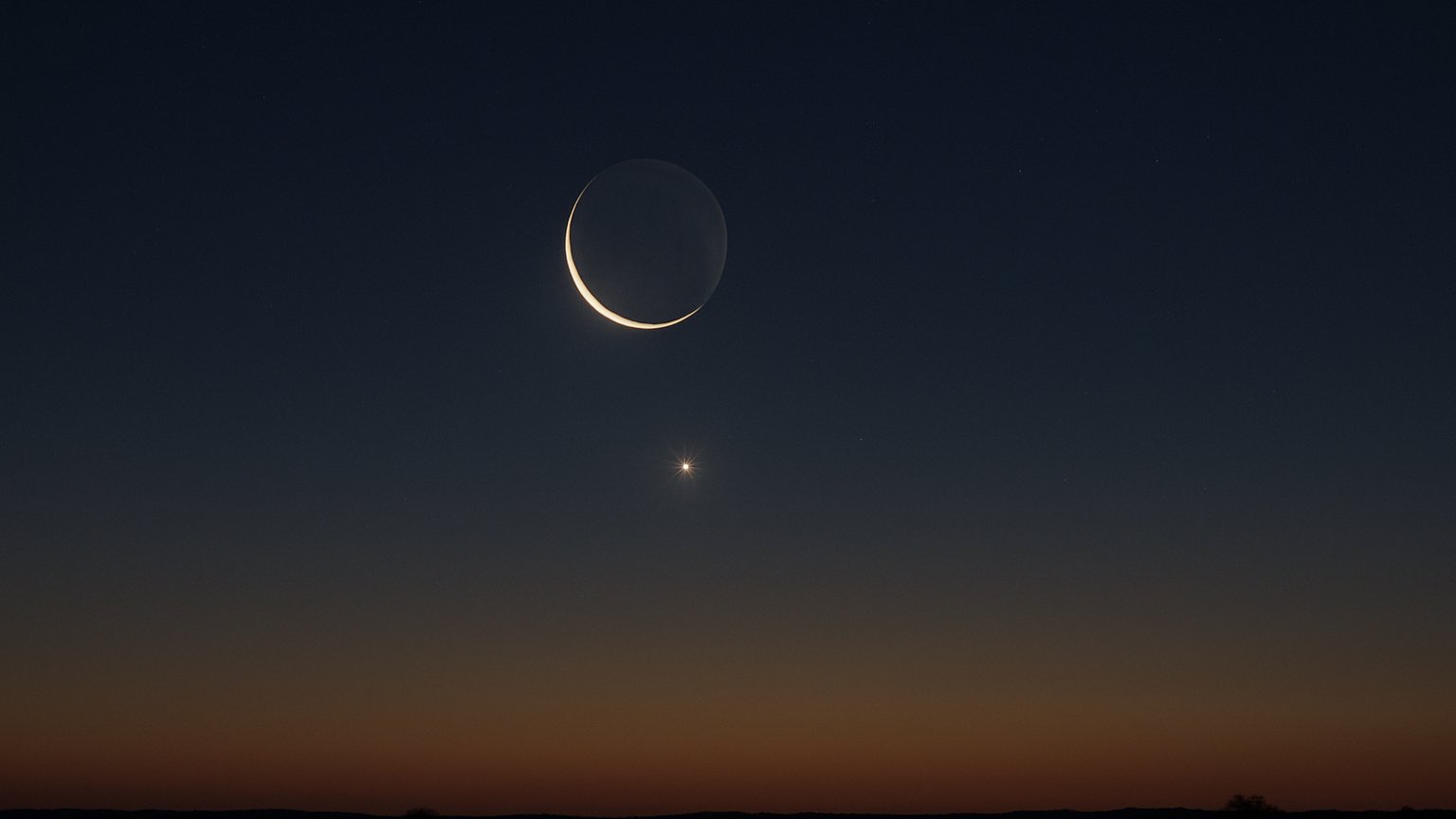
Before sunrise on November 7, 2026, the sky will offer a particularly striking close encounter between the Moon and Venus. Along a narrow path crossing southern South America, the Falkland Islands and Antarctica, the thin crescent Moon will pass directly in front of brilliant Venus. Outside that path, observers will still see the two bright objects less than 1 degree apart, with Spica nearby.
What will happen in the sky
The event is a lunar occultation of Venus. During an occultation, a nearby object in the sky appears to move in front of a more distant one. In this case, the Moon’s apparent disk will cross Venus and temporarily hide it from observers located within the visibility path.
The path of direct occultation will be narrow. It extends across parts of southern South America, the Falkland Islands and Antarctica, corresponding to Argentina, Chile, the Falkland Islands and Antarctica in the event information. Observers outside this zone will not see Venus disappear behind the Moon. Instead, they will see an exceptionally close conjunction: the Moon and Venus will remain less than 1 degree apart.
The Moon will be only a very thin crescent, with roughly 3% to 4% of its surface illuminated. That delicate crescent beside the intense brightness of Venus will make the scene visually distinctive, even where the occultation itself is not visible.
Why Venus can disappear behind the Moon
Venus is the brightest planet in Earth’s night sky, while the Moon is our nearest natural neighbor and appears large because of its proximity. Although Venus is much larger than the Moon in reality, the Moon’s much closer distance gives it a substantial apparent size in the sky. This allows its edge to pass across Venus from our viewpoint.
The Moon is constantly moving eastward against the background stars. As it follows its orbit around Earth, its position shifts relative to planets and stars. When its apparent path aligns with Venus, the Moon can cover the planet for observers in a particular region. Because the alignment is visible from only part of Earth, an occultation path is much narrower than the area from which a close pairing can be observed.
The brightness contrast is another reason this event is interesting. Venus is a brilliant point of light, while the crescent Moon presents a slim illuminated arc. Seeing the planet vanish behind that arc offers a direct visual demonstration of the Moon’s motion across the sky.
Where and when to look
The event date is November 7, 2026. Viewing is best before sunrise, when the Moon and Venus appear low in the eastern or east-southeastern sky. A clear horizon in that direction will be important, especially because the observation takes place in the pre-dawn sky.
Direct disappearance of Venus will be possible only along the narrow southern path across southern South America, the Falkland Islands and Antarctica. For observers elsewhere, the important feature is the close pairing rather than the occultation itself. The two objects will appear less than 1 degree apart, making them easy to recognize as a compact pair if the horizon and sky are clear.
No special event-specific timing is supplied here, so the most reliable description is the shared pre-sunrise viewing window. The thin crescent may be subtle, while Venus should stand out strongly because of its brightness.
A compact grouping with Spica
The morning sky will include more than the Moon and Venus. Spica will be nearby, creating a compact three-object grouping. This adds another point of interest to an already close arrangement: a very thin lunar crescent, the brilliant planet Venus and a nearby bright star.
The combination is unusual because it brings together an occultation visible from a restricted region and a close planetary-lunar pairing visible more broadly. Even where the Moon does not cover Venus, the scene will still show how orbital motion can bring bright celestial objects into striking alignment. For viewers within the southern path, the moment Venus disappears behind the Moon will be the defining feature; elsewhere, the close approach and nearby Spica will form the main spectacle.