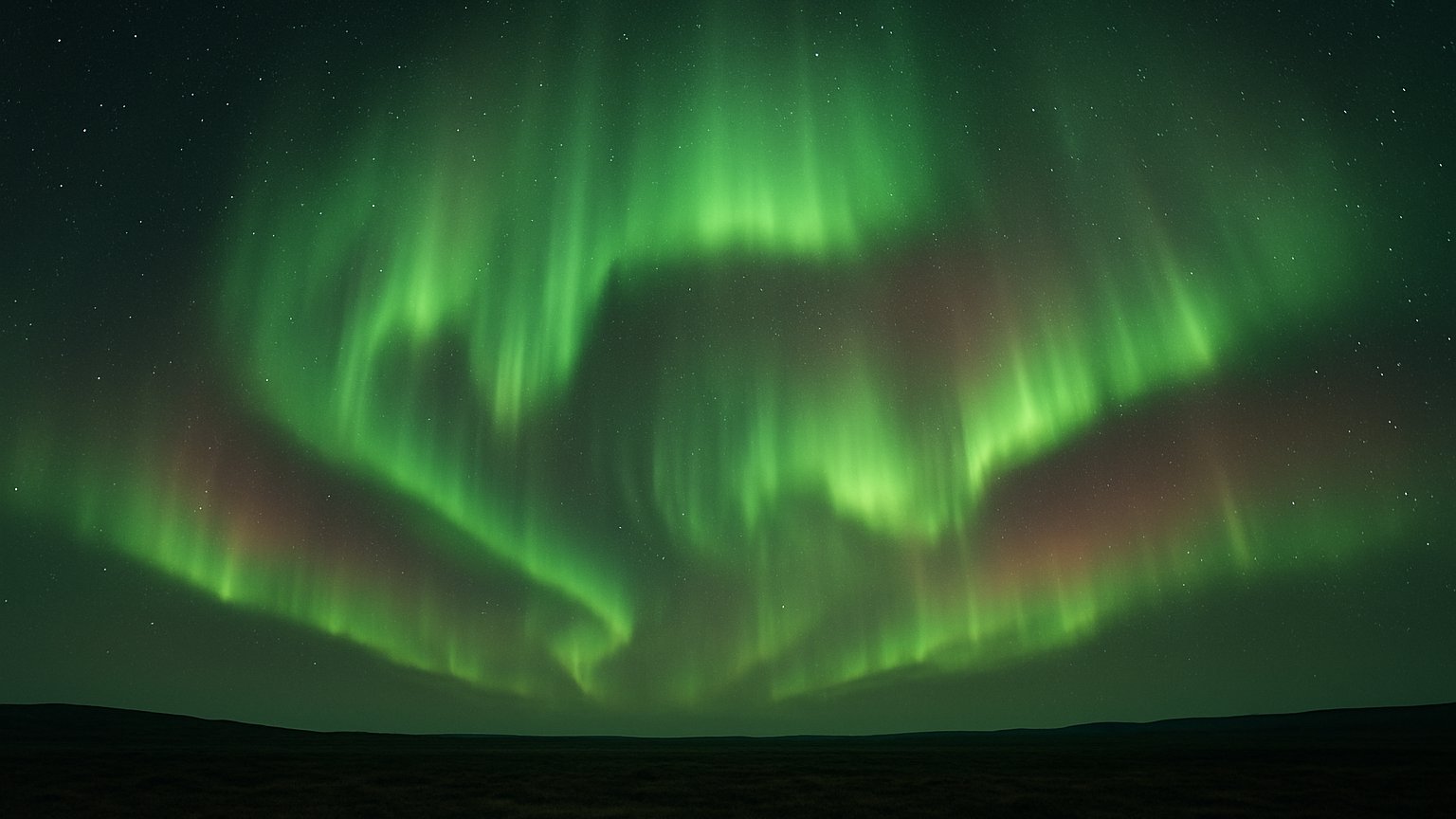
A minor geomagnetic storm is affecting Earth on November 8, as a fast stream of solar wind reaches the planet. The activity has raised the possibility of northern lights across Canada and, if conditions allow, parts of the northern United States. The display is expected to remain a low-risk natural phenomenon, but it could create striking colors for observers and photographers at high geomagnetic latitudes.
What is happening
NOAA space-weather data indicated that the planetary Kp index reached storm level 5 on November 8, 2026. This level corresponds to a minor G1 geomagnetic storm. At the same time, reported solar-wind speeds were near 700–750 kilometers per second, considerably faster than the slower background solar wind often observed around Earth.
The current activity is associated with a fast solar-wind stream from a coronal hole. A coronal hole is a region of the Sun’s outer atmosphere where magnetic-field lines can extend outward more freely into space. These regions can release streams of faster-moving solar particles. When such a stream reaches Earth, it can disturb the planet’s magnetic environment and increase the chance of auroral activity.
How the aurora forms
The northern lights appear when energetic particles connected with the solar wind interact with Earth’s magnetosphere, the large magnetic region surrounding the planet. The magnetosphere deflects much of the incoming solar material, but some particles can enter the upper atmosphere, particularly along magnetic-field lines near the polar regions.
As these particles collide with gases high above Earth, they transfer energy to atoms and molecules. Those gases then release some of that energy as light. The resulting glow can form arcs, bands, rays, or curtains that shift and ripple across the sky. Different atmospheric gases and altitudes contribute to different colors, with green and red among the familiar auroral hues.
A geomagnetic storm does not guarantee that every location will see auroras. Visibility depends on the strength and structure of the disturbance, the observer’s geomagnetic latitude, local darkness, cloud cover, and the brightness of the Moon or nearby artificial lights. The Kp index is useful as a broad measure of geomagnetic activity, but actual visibility can vary from one location to another.
Where the lights may be visible
Aurora visibility is favored at high geomagnetic latitudes. The most likely regions mentioned for this event include Canada, Alaska, and northern Europe. The northern tier of the United States may also have an opportunity to see the display, particularly if the activity reaches the necessary intensity and the sky is sufficiently dark and clear.
Across Canada, visibility may extend beyond the far-northern Arctic regions during periods of stronger activity. In the United States, the possibility is focused on northern areas rather than the country as a whole. Observers should look toward the northern sky from a location with as little artificial light as possible, while remembering that cloud conditions and local weather will determine whether the sky is actually visible.
A minor storm with a vivid visual possibility
The G1 classification describes the geomagnetic level, not a dramatic threat to people on the ground. For most observers, the principal effect is the possibility of a beautiful natural light display. A minor storm can still produce auroras that are visually interesting, especially when the glowing structures become active and move across the sky.
The event is also a reminder that the aurora is shaped by a chain of connected processes: conditions in a coronal hole on the Sun, the speed of the solar wind, its interaction with Earth’s magnetic field, and the response of the upper atmosphere. Even when the storm is classified as minor, that sequence can bring colorful auroral activity to regions well outside the Arctic.