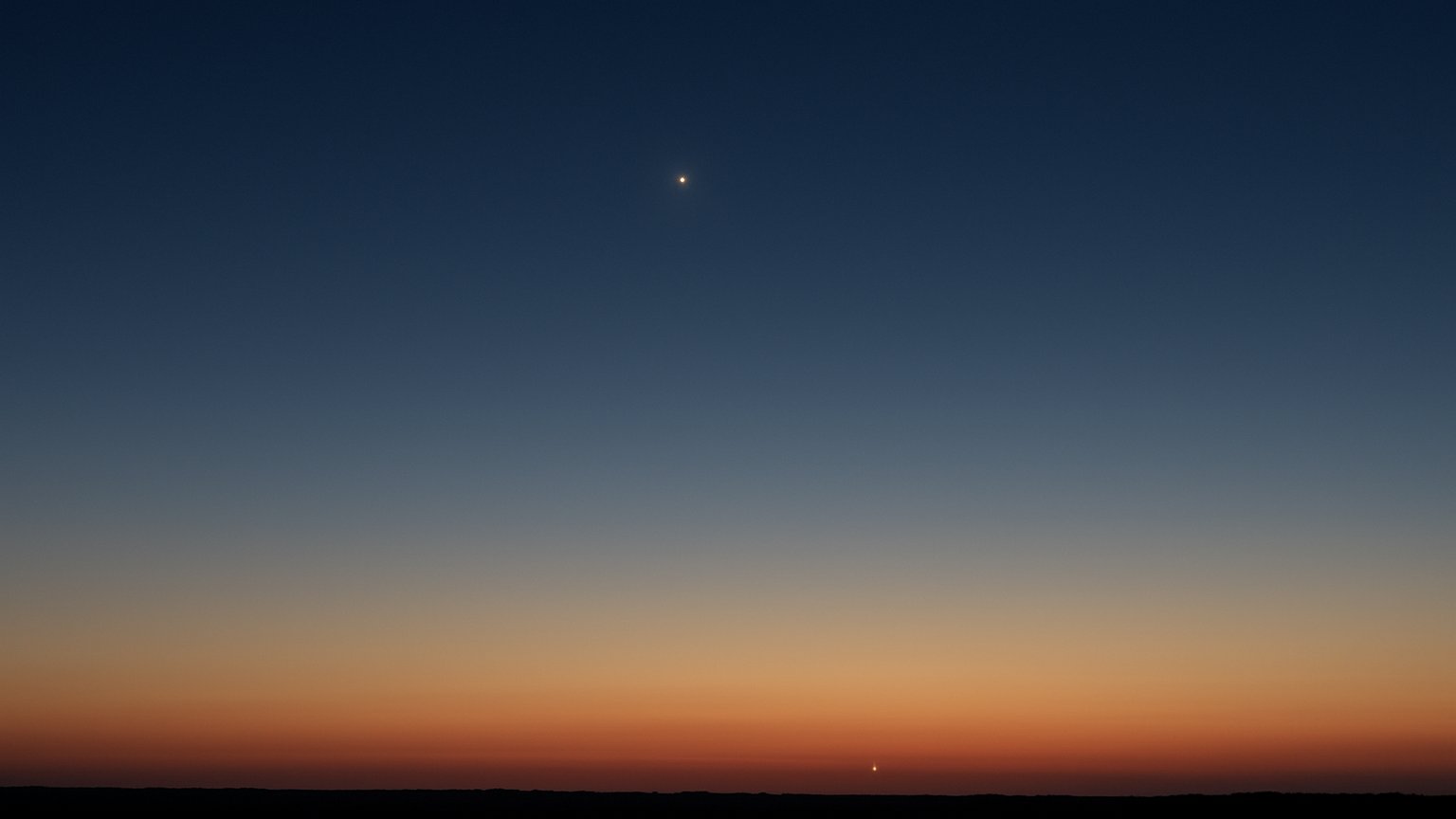
Mercury will reach its greatest western elongation on November 20, 2026, offering observers around the world a chance to search for the elusive planet before sunrise. At approximately 19.6 degrees west of the Sun, Mercury will appear at its farthest apparent distance from the Sun during this morning apparition. It will still be low above the eastern horizon, so a clear view toward the sunrise direction will be especially important.
What is happening in the sky
Greatest elongation is the point in an inner planet’s apparent path when it lies at its greatest angular distance from the Sun as seen from Earth. On this occasion, Mercury is west of the Sun. In practical terms, that means it appears in the morning sky and rises before the Sun does.
The event does not mean that Mercury is physically far away from the Sun in space. The measurement describes the angle between the planet and the Sun from our viewpoint on Earth. At an elongation of approximately 19.6 degrees, Mercury will be separated from the Sun by enough of an angle to become a possible pre-dawn target, while remaining close to the horizon.
Why Mercury is difficult to see
Mercury is the innermost planet of the Solar System and follows an orbit close to the Sun. From Earth, it therefore never travels very far from the Sun across the sky. Most of the time, the planet is lost in the bright twilight surrounding sunrise or sunset.
Greatest elongation creates a more favorable geometry. Because Mercury is west of the Sun during this apparition, it can be searched for in the eastern sky before sunrise, when the planet is above the horizon and the Sun is still below it. Even then, its low altitude and the growing brightness of dawn can make the view challenging. The planet’s proximity to the horizon also means that trees, buildings, terrain or haze may obstruct it, making an unobstructed eastern horizon valuable.
How and where to look
The event is visible worldwide in principle, with the best views from locations that offer a clear eastern horizon. Begin looking low toward the east before sunrise on November 20. Dark or low-light conditions will improve the chance of spotting Mercury, although the planet’s low position means that local surroundings and atmospheric clarity will strongly affect visibility.
A useful approach is to choose a site where the horizon is open and to scan the area above the eastern horizon before the sky becomes bright. Mercury will not appear high overhead; its location near the horizon is a defining feature of this morning appearance. Exact viewing conditions will vary from place to place because sunrise and the local landscape differ, but the essential direction remains the same: east, before sunrise.
A possible planetary lineup
Mercury may also form part of a broader pre-dawn planetary lineup with Venus, Mars and Jupiter. The research describes this as a possibility rather than a guarantee that all four planets will be equally easy to see from every location. Their visibility will depend on the local horizon, the amount of twilight and the clarity of the sky.
That wider setting adds interest to Mercury’s elongation. The planet is often overlooked precisely because it stays so close to the Sun, and these favorable viewing geometries are comparatively limited. On November 20, its position about 19.6 degrees west of the Sun provides one of the year’s better opportunities to look for it in the morning sky without confusing the event with a high-altitude appearance.