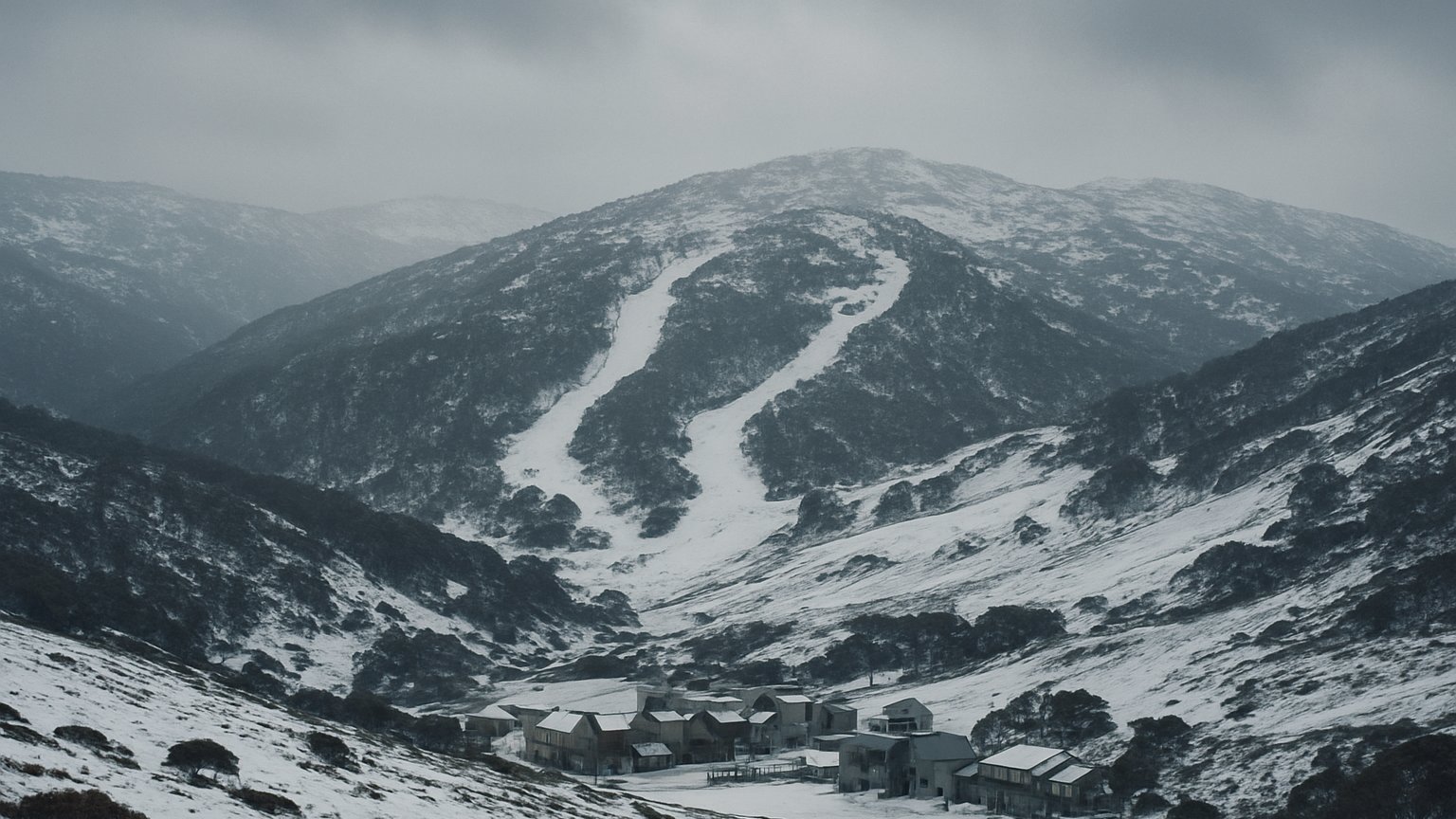
Snow is still visible across Australia’s southeastern alpine resorts even though the Southern Hemisphere is approaching summer. On November 9, lingering snow covered parts of New South Wales and Victoria, creating a striking contrast with the much warmer conditions recently experienced at lower elevations.
Where snow remains on November 9
The late-season snow is reported at Thredbo and Perisher in New South Wales, as well as Mount Baw Baw in Victoria. Thredbo and Perisher received up to approximately 3 centimetres of snow. In Victoria, Mount Baw Baw recorded approximately 5 to 10 centimetres.
These amounts are modest compared with the deep accumulations associated with the main winter season, but they are visually significant so late in the year. Snow remaining on the ground in early November is especially noticeable because the surrounding calendar suggests that the transition toward summer should already be well underway.
The event is therefore less about a major snowstorm than about a persistent alpine wintry scene appearing at an unusual point in the seasonal cycle. Snow cover and cold conditions remain visible in elevated areas while warmer weather is present elsewhere in southeastern Australia.
A sharp contrast in temperatures
The cold conditions in the alpine areas followed temperatures near 30 degrees Celsius in parts of Sydney. That contrast highlights how quickly conditions can differ between lower-lying urban areas and high mountain environments, and how rapidly a cold outbreak can change the weather over a relatively short distance.
At Thredbo, the forecast minimum for November 9 was around -6 degrees Celsius. A temperature at that level supports the persistence of snow and allows wintry conditions to continue even as November advances.
A forecast minimum is the expected lowest temperature during the relevant overnight or early-morning period. In a mountain setting, cold overnight air can help preserve existing snow by limiting melting, particularly when the snow surface is shaded or when daytime warmth is brief.
Why snow can occur so late in spring
Australia’s alpine resorts are in the Southern Hemisphere, where November falls in late spring rather than late autumn. Seasonal averages generally move toward warmer conditions at this time of year, but individual cold outbreaks can still bring temperatures low enough for snow at high elevations.
Snow forms when moist air rises into sufficiently cold parts of the atmosphere. If temperatures remain at or below freezing through the layer between the cloud and the ground, precipitation can reach the surface as snow. Elevation is important because air temperature usually decreases with height, leaving mountain locations colder than nearby lowlands.
Once snow has fallen, its survival depends on several factors, including air temperature, sunlight, wind and the condition of the snowpack. Cold nights can slow melting, while milder days encourage it. This combination can leave patches or a thin covering visible even when the wider region is experiencing a much warmer spring pattern.
An unusual visual marker of the season
The most interesting feature of this event is the contrast between timing and appearance. Snow at Thredbo, Perisher and Mount Baw Baw offers a clear visual reminder that seasonal change is not uniform across a landscape. Summer may be approaching on the calendar, yet altitude continues to shape local weather and ground conditions.
The event is also notable in the context of an unusually warm winter mentioned in the research. Against that background, a late-season cold outbreak and fresh snow stand out more strongly. The snow provides compelling photo and video opportunities, but the available information does not indicate a severe or widespread weather disaster.
Instead, this is a short-lived, seasonally unusual alpine episode: modest snowfall, cold mountain temperatures and a sharp contrast with warmth in parts of Sydney. Together, those details explain why snow remains visible across southeastern Australia in early November.