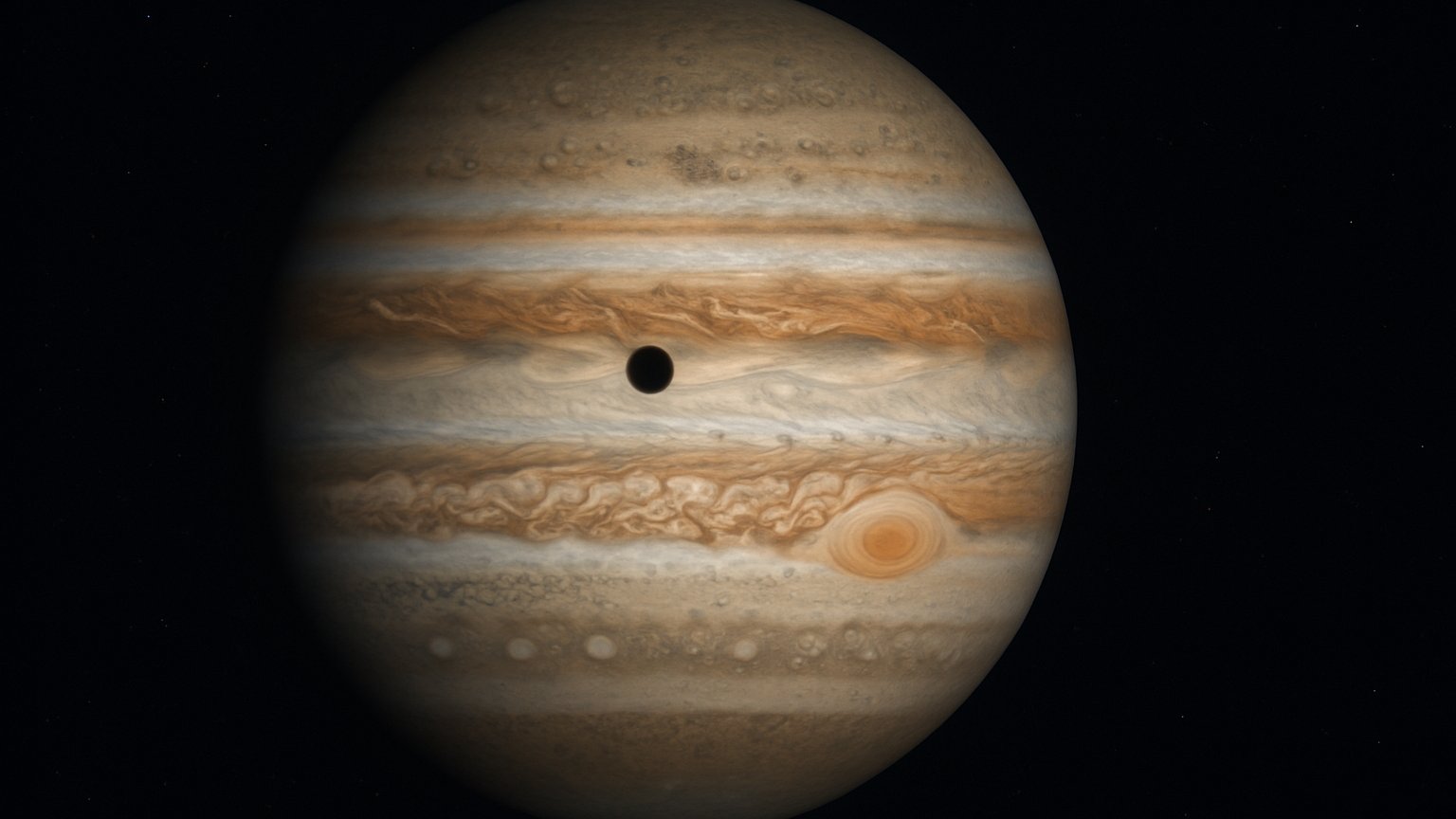
On November 18, 2026, observers with telescopes will have the opportunity to watch a small but remarkable orbital event: the shadow of Ganymede, the largest moon in the Solar System, will begin moving across Jupiter’s cloud tops at approximately 09:20–09:25 UTC. From locations where Jupiter is above the horizon, the event will appear as a dark spot travelling across the planet’s bright, banded disk.
What will happen on November 18
The event is a Jovian moon shadow transit. In simple terms, Ganymede will pass between the Sun and Jupiter, allowing its shadow to fall on the giant planet. The shadow will begin crossing Jupiter at approximately 09:20–09:25 UTC on November 18, 2026.
The most important visual feature is the contrast between the dark shadow and Jupiter’s cloud bands. Jupiter is already a striking telescopic target, but a moving spot on its disk makes the planet appear active rather than static. The transit turns the motion of a distant moon into something that can be followed directly at the eyepiece.
Visibility depends on the observer’s location and the position of Jupiter in the sky. The event can be observed from locations where Jupiter is above the horizon at the relevant time. Because the shadow is small compared with Jupiter’s full disk, a telescope is required to see it clearly.
How a moon’s shadow reaches Jupiter
A shadow transit is a predictable result of orbital alignment. Sunlight travels past Ganymede toward Jupiter, and when Ganymede is positioned between the Sun and the planet, it blocks a small portion of that light. The resulting shadow falls on Jupiter’s upper cloud layers as Ganymede moves along its orbit.
The same basic geometry produces eclipses elsewhere in the Solar System. What makes this event especially interesting is that the alignment can be watched on another world. Instead of seeing a shadow cross Earth’s surface, observers see Ganymede’s shadow projected onto Jupiter, with the planet’s cloud bands providing a natural background.
Ganymede’s status as the largest moon in the Solar System adds another layer of interest. It is not simply an anonymous point orbiting Jupiter; it is a giant moon whose movement can produce a visible mark on the atmosphere of the largest planet in the Solar System.
What to look for through a telescope
The shadow should appear as a dark, moving spot against Jupiter’s brighter cloud tops. Its movement is the key to identifying the event. A single observation may show only a dark mark, but watching Jupiter over time reveals that the spot changes position across the disk.
Jupiter’s cloud bands provide the backdrop, so the visibility of the shadow can depend on the contrast between the spot and the atmospheric features behind it. A telescope is necessary for a clear view, and the event also offers useful material for telescope photography and time-lapse videos.
Observers should plan around the stated UTC start time and first confirm that Jupiter is above the horizon from their location. Local observing conditions can affect the view, but the essential requirement is a telescope and a clear line of sight to the planet.
A real-time demonstration of orbital mechanics
Many astronomical motions are difficult to appreciate because they take place over enormous distances or long periods. A shadow transit makes orbital mechanics more tangible. Ganymede’s orbit, the direction of sunlight and Jupiter’s position line up to create a moving feature that can be watched as it develops.
The event also connects two very different worlds: Jupiter, with its bright cloud bands, and Ganymede, the Solar System’s largest moon. Their relationship is visible through the changing position of the shadow. For observers and astrophotographers, this makes November 18 an opportunity to see a precise celestial alignment unfold in real time rather than only as a diagram or calculation.