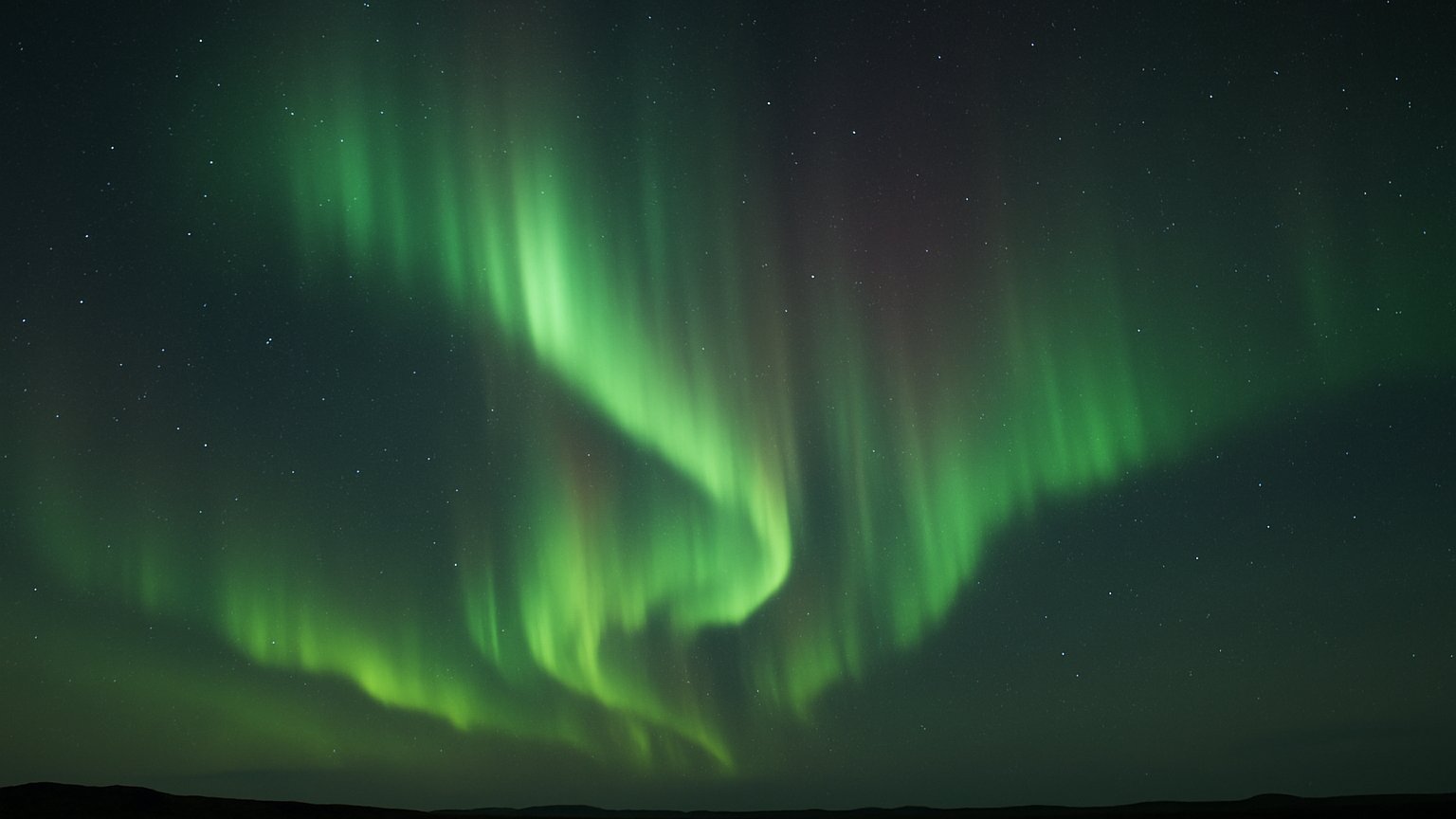
A minor geomagnetic storm may give skywatchers across the far north a chance to see the aurora late on November 26, 2026. NOAA-related forecasts indicate that a stream of fast solar wind could raise geomagnetic activity to the G1 storm level. If conditions develop as expected, northern lights may appear across Alaska, Canada, northern Europe, and the northern tier of the United States.
What is expected
The forecast calls for possible G1 geomagnetic storm conditions late on November 26. G1 is the lowest category on the five-level NOAA geomagnetic storm scale, so this is a minor storm rather than a major space-weather event. Even so, relatively modest disturbances can produce striking auroras when the viewing conditions are favorable.
The event is associated with a coronal-hole high-speed stream. A coronal hole is a region of the Sun where the magnetic field allows solar wind to escape more readily into space. The resulting stream can travel faster than the surrounding solar wind. When that faster flow reaches Earth, it can disturb the planet’s magnetic environment and increase the chance of auroral activity.
The forecast describes a possibility, not a guarantee that an aurora will be visible from every listed region. Geomagnetic activity can vary, and the visibility of the lights depends on the strength and timing of the disturbance as well as local observing conditions.
How the northern lights form
Earth is surrounded by a magnetic field that helps guide charged particles from the solar wind around the planet. During periods of increased solar-wind activity, some of those particles can enter the upper atmosphere, particularly near the polar regions.
As the particles collide with gases high above Earth, they transfer energy to atoms and molecules. Those gases then release part of that energy as light, creating the shifting curtains, arcs, and bands known as the aurora. Oxygen and nitrogen in the atmosphere contribute to the range of colors that can appear, although the exact appearance depends on altitude, atmospheric composition, and the energy of the incoming particles.
The aurora is therefore not a cloud or weather system in the ordinary sense. It is a light display produced by interactions between the solar wind, Earth’s magnetic field, and the upper atmosphere. Its connection with space weather is what makes geomagnetic storm forecasts useful to skywatchers.
Where the aurora may be visible
Aurora visibility is favored across Alaska, Canada, northern Europe, and the northern tier of the United States. These areas are closer to the auroral zone, where particles guided by Earth’s magnetic field most often produce visible activity.
The forecast also refers to other high-latitude regions as possible viewing areas. However, the actual extent of the display can change as the solar-wind stream interacts with Earth. A G1-level disturbance does not mean that the lights will be visible throughout all of these regions, and visibility may differ from one location to another.
For observers, darkness and a clear view of the sky are essential. Artificial light can make faint auroras difficult to detect, while clouds can hide even a strong display. Because the forecast concerns activity late on November 26, observers interested in the possibility should pay attention to conditions during that period rather than expecting the aurora to remain visible continuously.
Why this event is worth watching
This forecast is interesting because it combines a relatively minor level of geomagnetic activity with the possibility of a large-scale visual effect. The northern lights may be visible across parts of Canada and the northern United States as well as across Alaska and northern Europe, giving many high-latitude skywatchers an opportunity to look for or photograph the phenomenon.
The event also illustrates how features on the Sun can influence conditions around Earth. A coronal hole may look dark in solar images, but the high-speed solar wind flowing from it can become important for space-weather forecasting. In this case, that stream is expected to raise activity to G1 levels late on November 26.
Whether the display becomes bright, widespread, or faint will depend on how the solar wind and Earth’s magnetic field interact. The safest expectation is a chance of aurora in favored high-latitude regions—not a guarantee of a visible show everywhere.