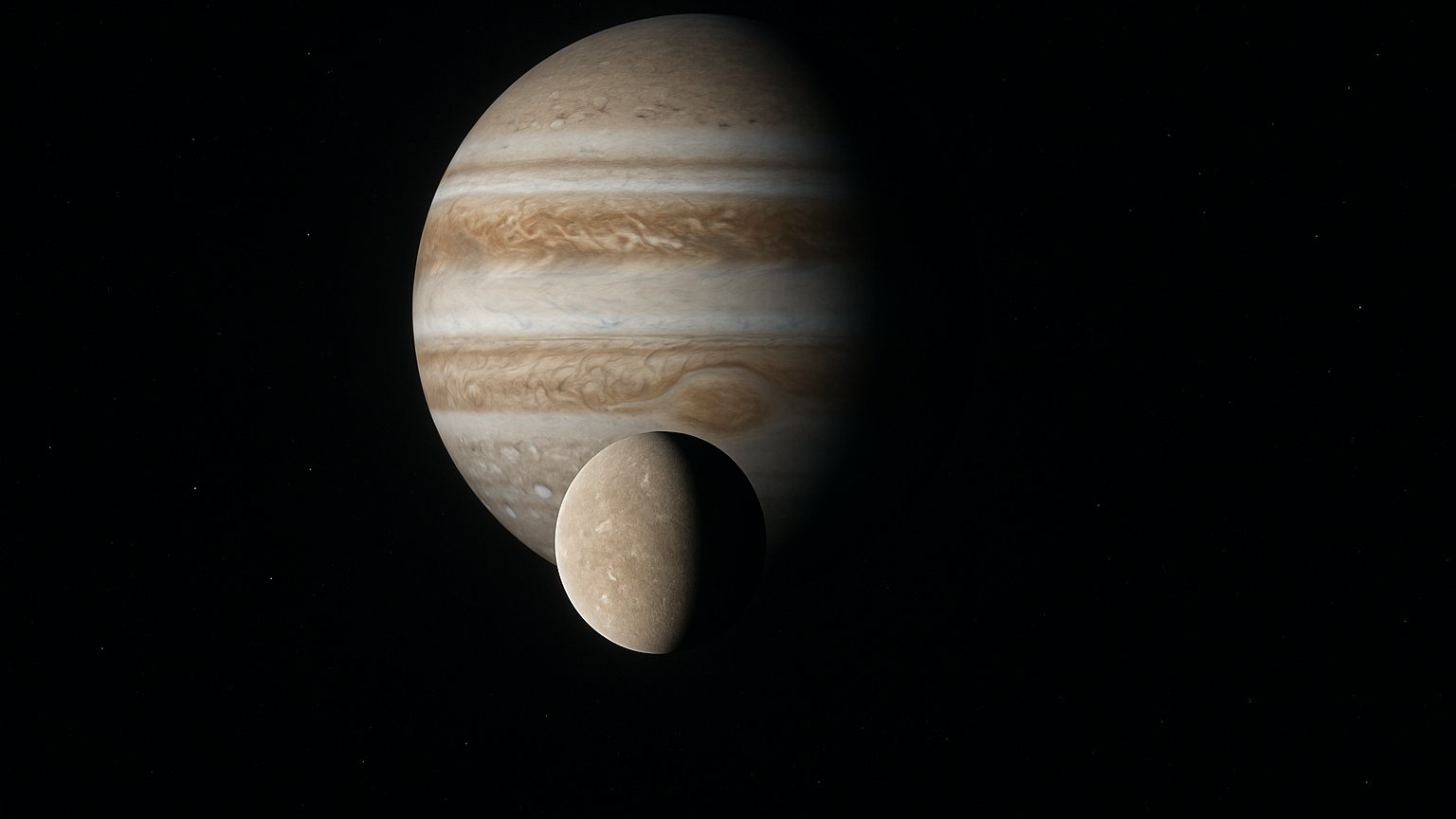
On November 21, 2026, two of Jupiter’s largest moons are expected to create a brief and precisely timed event for telescope observers. Europa will pass in front of Ganymede, temporarily covering part of the Solar System’s largest moon. The occultation is predicted to begin at approximately 11:32 UTC and last about 12 minutes, offering a compact but striking demonstration of orbital motion around Jupiter.
What is expected to happen
An occultation occurs when one celestial body moves across the line of sight to another and blocks part or all of it from view. In this case, Europa will cross in front of Ganymede as seen from Earth. Forecast calculations indicate that approximately 52% of Ganymede’s visible disk could be obscured during the event.
This does not mean that Ganymede disappears completely. Instead, a substantial portion of its small apparent disk will be hidden for a limited period before the two moons separate again in the telescope’s view. Because the event is predicted to last only around 12 minutes, observers will need to be ready before the calculated start time.
The beginning is listed as approximately 05:32 Central Standard Time, equivalent to about 11:32 UTC. As with any observation involving Jupiter’s moons, the exact experience depends on the observer’s location and local sky conditions.
The science behind the occultation
Jupiter’s four Galilean moons—Io, Europa, Ganymede and Callisto—are constantly moving in orbit around the giant planet. Their paths repeatedly change their positions relative to one another and to observers on Earth. Most of the time, the moons appear separated or pass close together without one covering another. Occasionally, however, their orbital geometry aligns so that one moon crosses directly in front of another.
These events are called mutual occultations. They are relatively uncommon compared with the continuous orbital motion of the moons, which is why a direct crossing can be especially interesting through a telescope. The changing view is also a clear, time-limited illustration that the moons are not fixed points beside Jupiter: they are active members of a compact orbital system.
During this event, Europa’s apparent path will carry it across Ganymede’s disk. The amount of Ganymede hidden depends on the precise alignment of the two moons as viewed from Earth. The forecast of roughly 52% represents a significant partial occultation rather than a total one.
Where and when to observe
The event is visible telescopically from parts of Earth where Jupiter is above the horizon. Visibility also depends on local darkness, Jupiter’s altitude and the size of the telescope being used. These factors determine whether Jupiter is in a practical position for observation and whether the two small moon disks can be distinguished clearly.
A telescope is essential for this event. Jupiter’s moons are much easier to study with optical aid, and the occultation is a subtle change in the appearance of two small points or disks close to the bright planet. Observers should locate Jupiter ahead of time, confirm that the planet is above the horizon, and be prepared before approximately 11:32 UTC.
The timing is global, but the observing circumstances are not. A location where Jupiter is low, daylight has begun, or clouds obscure the sky may not offer a useful view. The event’s short duration makes preparation particularly important.
Why this event is notable
The Galilean moons are always in motion, yet direct mutual occultations remain relatively uncommon. This event is notable because Europa is forecast to hide about half of Ganymede for several minutes rather than merely passing nearby. Through a telescope, the changing overlap should provide a visually direct example of the orbital relationships within the Jovian system.
The event also belongs to a period in which Jupiter’s orbital geometry produces multiple mutual events among its moons. Each one is brief, but together they reveal how changing alignments can transform the appearance of the system from Earth. On November 21, Europa’s passage across Ganymede will turn that geometry into a short astronomical appointment.