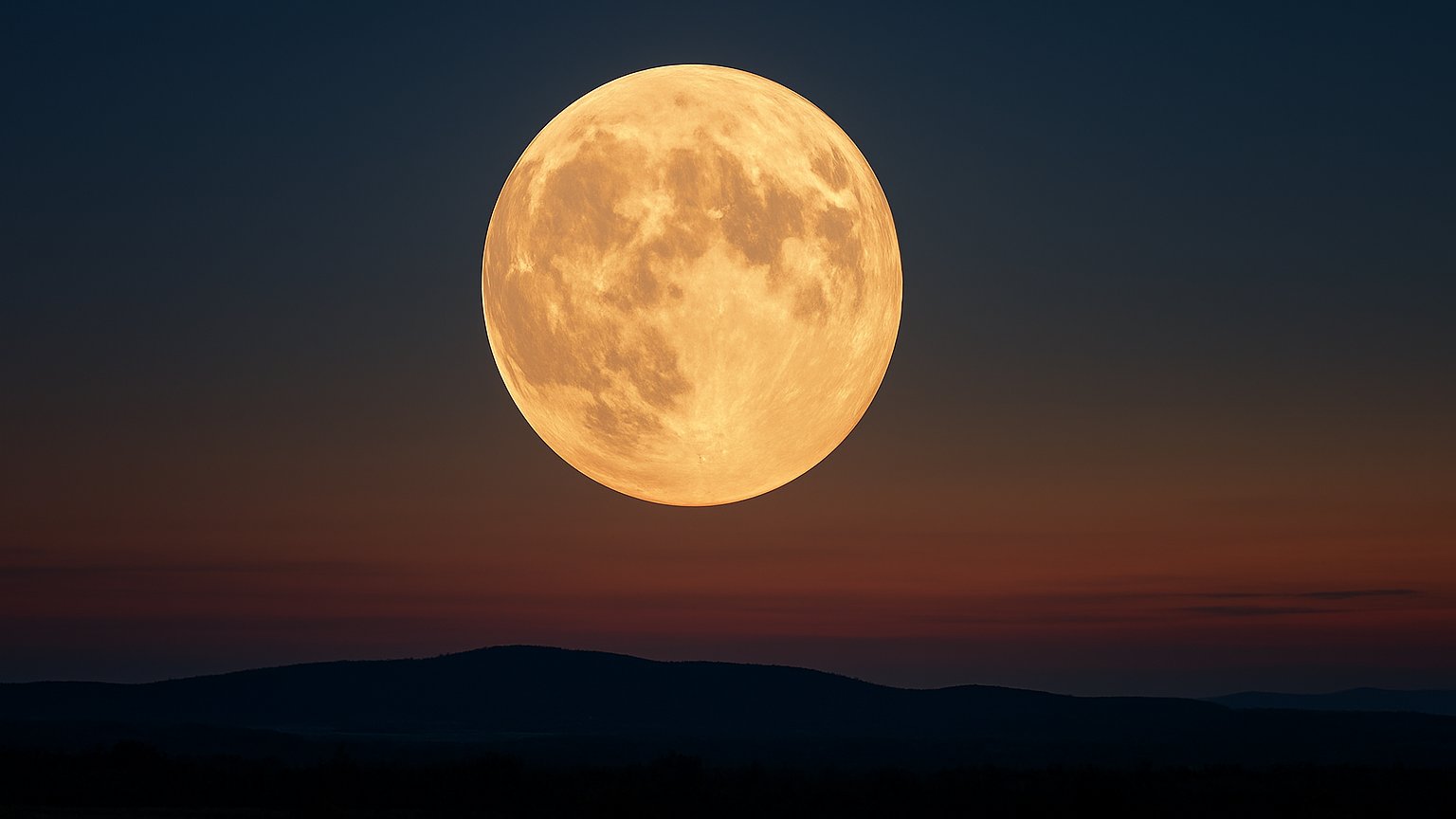
The November full Moon will arrive with a small but measurable advantage in size and brightness. On November 24, 2026, the Beaver Supermoon reaches its peak at approximately 14:54 UTC, offering a widely visible sky event that needs no telescope. From locations with a clear eastern horizon, the Moon should rise around sunset and remain visible through the night, provided clouds do not interfere.
What happens on November 24
A supermoon occurs when a full Moon takes place while the Moon is near perigee, the closest point to Earth in its elliptical orbit. The November 24 full Moon meets that condition. Because the Moon is somewhat closer than it is during a more distant full Moon, it appears somewhat larger and brighter in the sky.
The event is global rather than limited to a particular region. Local moonrise times will vary, however, so the Moon will not appear at exactly the same moment everywhere. The most useful viewing conditions are simple: an unobstructed view toward the east around moonrise, followed by a location with as little cloud cover as possible.
Why the Moon can look larger and brighter
The Moon’s orbit around Earth is not a perfect circle. Its elliptical shape means the distance between Earth and the Moon changes during each orbit. Perigee is the point at which the Moon is closest to Earth, while the more distant part of the orbit is called apogee.
A full Moon near perigee therefore has a slightly larger apparent diameter than a full Moon farther away. NASA says a supermoon can appear up to 14% larger and 30% brighter than the year’s faintest full Moon. These figures describe the possible comparison across the year, not a dramatic transformation visible from every location. The difference is real, but the Moon will still look recognizably like a full Moon.
Brightness also depends on viewing conditions. Thin cloud, haze, light pollution and the Moon’s position above the horizon can all affect how bright it appears to an observer. The clearest impression is likely to come from comparing the event with other full Moons rather than expecting a sudden change during the night.
Where and when to look
The Beaver Supermoon is visible worldwide, although the exact timing depends on local conditions. Look toward the eastern horizon around sunset for moonrise. As the night progresses, the full Moon will travel across the sky and remain available for observation, weather permitting.
A clear horizon is especially helpful at moonrise, when trees, buildings or hills can hide the lower part of the sky. Cloud cover is the main short-term uncertainty: the event itself occurs everywhere, but an overcast sky can prevent it from being seen. No telescope is required. Binoculars may reveal lunar surface detail, but the full Moon is easily observed with the unaided eye.
The beginning of a supermoon sequence
This full Moon is interesting not only because it is near perigee, but also because it begins a sequence of three consecutive supermoons. That gives skywatchers more than one opportunity to observe the visual effect and compare the Moon’s appearance across successive full-Moon events.
The supermoon is an accessible example of how orbital geometry changes what we see from Earth. A shift in the Moon’s distance, combined with the timing of the full phase, produces a noticeable but natural variation in apparent size and brightness. On November 24, the best approach is simply to find a clear eastern horizon, check local moonrise conditions and watch the sky from around sunset into the night.