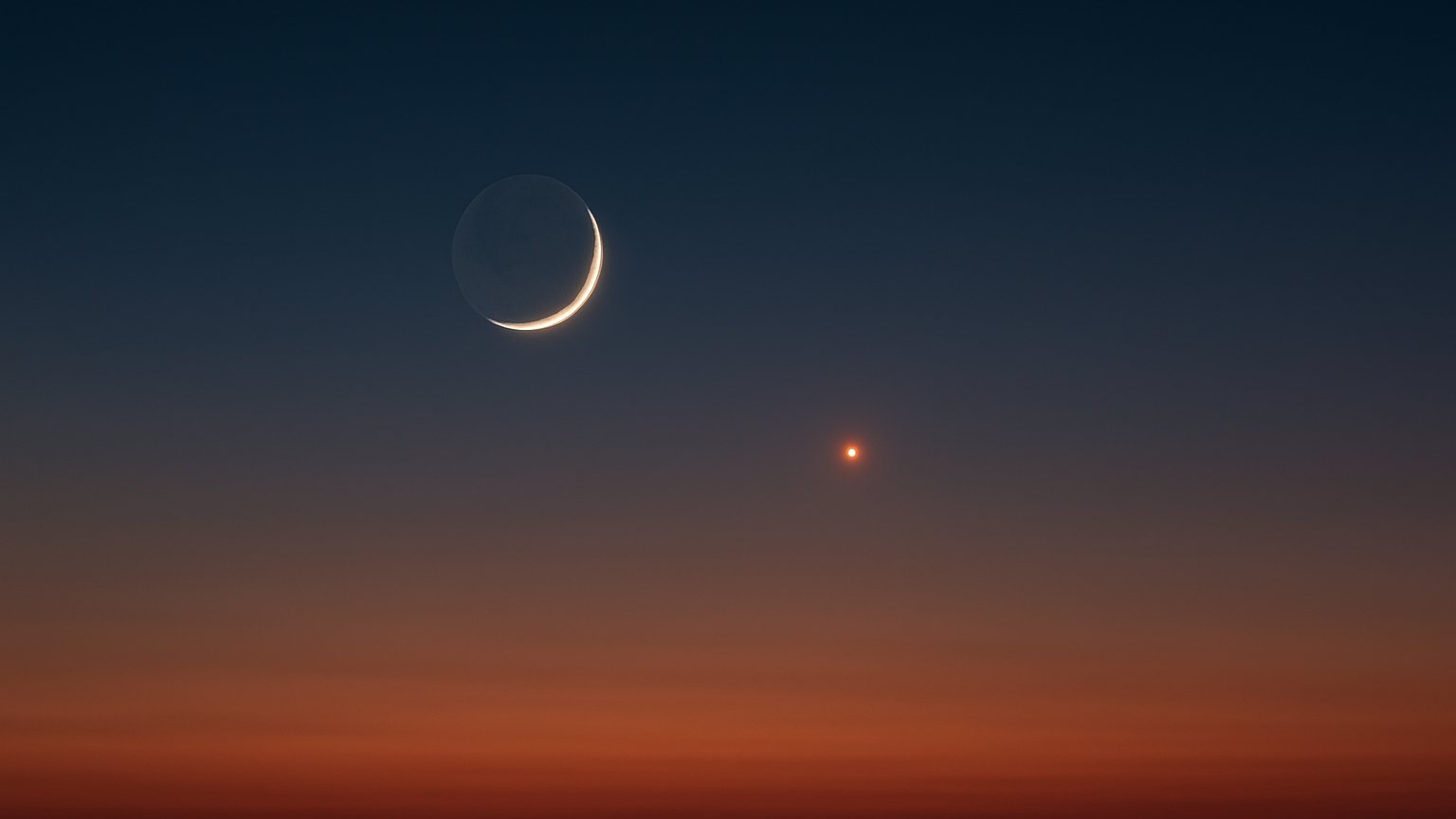
A razor-thin crescent Moon and the orange-red star Antares will share the evening sky on November 10, 2026. The Moon will be illuminated by only a few percent, giving it a delicate hairline appearance as it hangs low in the western sky after sunset. The pairing should be especially attractive in photographs, where the Moon’s bright curve can contrast with the warm color of the star.
What will appear in the sky
This event is an apparent close pairing between the Moon and Antares, rather than a physical meeting in space. The two objects will look close together from Earth as they pass through the same region of the sky. Antares is a reddish star, while the young Moon will show only a narrow illuminated edge because it is still near the beginning of its waxing phase.
The view will be low above the western horizon. That makes the timing important: the pair should be sought shortly after sunset, before both objects sink below the horizon. The viewing opportunity will therefore be brief, and a clear view toward the west will be more important than having specialized equipment.
Why the Moon looks like a thin crescent
The Moon does not produce its own visible light. We see sunlight reflected from its surface, and the visible fraction changes as the Moon moves around Earth. During this young waxing crescent phase, only a few percent of the lunar disk will be illuminated from our perspective. The rest of the Moon’s apparent disk will be much fainter against the twilight sky.
A thin crescent is often easiest to notice while the sky is still changing from daylight to darkness. The remaining sunlight can make the scene colorful, while the bright edge of the Moon provides a clear shape. Because the Moon will be low in the sky, atmospheric haze near the horizon may affect how sharply it appears, so an unobstructed western horizon will be valuable.
Antares and the color contrast
Antares is known for its orange-red appearance. Its color comes from its relatively cool surface compared with hotter, bluer stars. Against the fading blue and warm tones of twilight, that reddish color may stand out beside the pale crescent.
The contrast between the hairline Moon and Antares is the main visual appeal of this conjunction. It is also an accessible event: the pairing is easy to explain and does not require a telescope. Binoculars may help locate the objects in a bright twilight sky, but observers should use them only after the Sun has fully set and never point them at the Sun.
Where and when to look
The evening pairing will be visible in much of the Americas and in other low-latitude regions that have a clear western horizon. On November 10, look shortly after sunset toward the west. Since the objects will be close to the horizon, buildings, trees, hills and haze could hide them or shorten the available viewing time.
The closest apparent approach occurs around November 11 in Universal Time, but the pairing is visible during the evening of November 10 across much of the Americas. The exact appearance will depend on the observer’s location and local sunset, so the best strategy is to begin looking soon after sunset rather than waiting for full darkness.
This is a small-scale but rewarding sky event: a young Moon, a colorful star and a narrow window of twilight visibility coming together in one low western scene.